
On this page+
In short
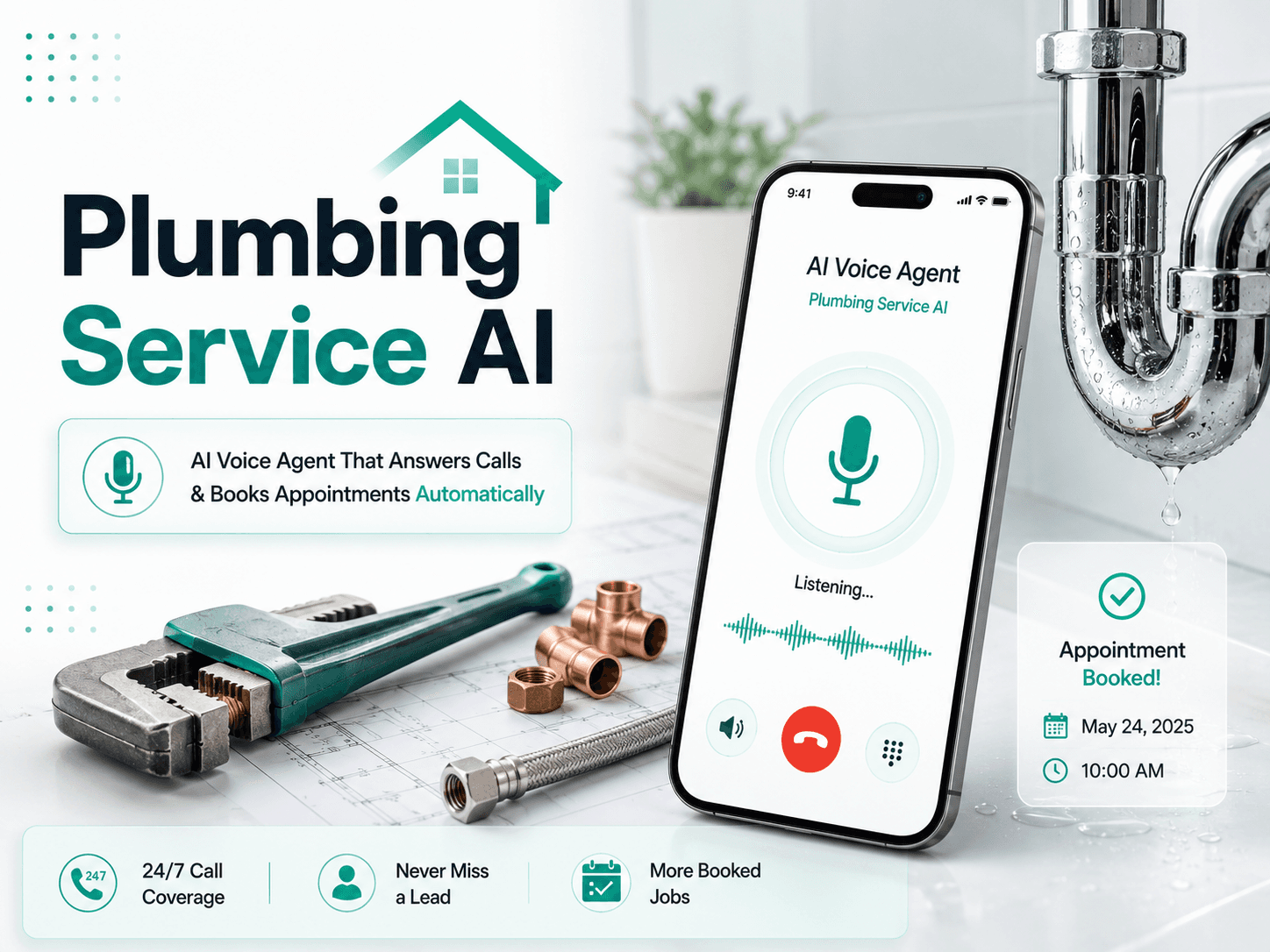
A plumbing business that misses a call usually loses the job — the caller rings the next plumber within minutes. An AI voice agent answers on the second ring, works out whether it's an emergency, books it into your calendar and texts the confirmation. Set up properly it takes about ten minutes; set up badly it books jobs you can't service and records calls you had no consent to record.
- Most plumbers lose jobs to voicemail, not to price — the caller simply rings the next number.
- Triage matters more than answering: an emergency and a quote request should not be handled the same way.
- Book during the call. A promised callback is a lost job.
- Sort call-recording consent and AI disclosure before you go live, not after.
A plumbing business does not usually lose a job on price. It loses it on the third ring.
Someone whose kitchen is filling with water is not leaving a voicemail and waiting. They are hanging up and calling the next plumber on the search results page, and by the time you finish the job you are on and check your phone, that work has been booked, done and paid for by someone else.
This is the problem an AI voice agent solves — and the reason it is worth more to a plumber than to almost any other trade. But it only works if you set it up to do the right thing on the call, and there is a compliance step most people skip that can turn a good idea into a legal problem.
Why missed calls cost plumbers more than most trades
Three things make plumbing unusually unforgiving:
- The work is urgent. A leak is not a purchase someone thinks about for a week. It is a decision made in the next four minutes.
- You cannot answer while you work. You are under a sink, in a loft, or lying in a puddle with both hands occupied. The phone rings at exactly the moment you cannot pick it up.
- The caller has a list. They searched, they got ten numbers, and they are working down it.
Put those together and the missed call is not a deferred job. It is a lost one.
What an AI voice agent actually does on the call
It is easy to imagine "AI answers the phone" as a robot reading a script. What actually happens on a well-configured agent is closer to a competent receptionist who never sleeps:
- Answers on the second ring, every time, including at 11pm on a Sunday.
- Announces that it is an AI and that the call is recorded — see the compliance section below.
- Works out what kind of call this is. Emergency? Quote? Existing customer rebooking?
- Routes accordingly: transfer the emergencies, book the routine work, capture the quotes.
- Writes it all back into GoHighLevel — the transcript, the contact, the opportunity.
- Texts the caller a confirmation so they stop calling other plumbers.
That last step matters more than it looks. A booking the caller has in writing is a booking they stop shopping around for.
Triage is the part that earns the money
The mistake most people make is measuring the agent on whether it answered. Answering is table stakes. The value is in what it does next.
An emergency and a quote request look identical for the first three seconds of a call and should be handled completely differently after that:
| Call type | What the caller needs | What the agent should do |
|---|---|---|
| Burst pipe, active leak | Someone now | Live-transfer to whoever is on call; if nobody answers, text you the address immediately |
| Boiler not firing, no water damage | A slot today or tomorrow | Book into the calendar, confirm by SMS |
| Bathroom refit quote | A price and a conversation | Capture scope and budget, book a survey, add to pipeline |
| Existing customer, annual service | To be recognised | Look up the contact, book their usual slot, confirm |
How to configure this in Spark AI
In the agent's routing rules, define an urgency question near the top of the script — "Is water escaping right now?" is a better question than "Is this an emergency?", because callers under stress overstate and understate almost at random, whereas a concrete question gets a concrete answer.
Then set the escalation: urgent calls live-transfer, everything else books. Give the transfer a fallback, because the whole point is that you are sometimes unable to answer.
Book during the call, never after
If your agent's outcome is "we'll call you back to arrange a time", you have built a very expensive answering machine.
The booking has to happen while the caller is still on the phone, against your real calendar, with your real availability. That means connecting the agent to the GoHighLevel calendar the job will actually be done from, and setting:
- your genuine working hours, not aspirational ones;
- travel buffers between jobs, so it does not book you in two towns at once;
- a daily cap, so a busy morning does not produce a schedule you cannot physically drive.
Get those wrong and the agent will cheerfully book eleven jobs across forty miles and you will spend the day apologising.
The compliance step people skip
This is the part that gets glossed over in most "AI answers your phone" pitches, and it is the part most likely to cause you an actual problem.
Your agent records and transcribes phone calls. That is regulated, and the rules depend on where your caller is:
- Some US states require one-party consent — you consenting is enough.
- Others — California, Florida, Illinois, Pennsylvania, Washington and more — require all parties to consent before recording. A call that crosses a state line can pull you into the stricter rule.
- In the UK and EU, you need a lawful basis under GDPR and callers must be informed.
Separately, a growing number of places require you to disclose that the caller is speaking to an AI, particularly in a commercial context.
A realistic setup checklist
Ten minutes gets it installed. An afternoon gets it right.
- Install the Plumbing Service AI agent into the GoHighLevel sub-account you actually take calls on.
- Connect the phone number, the calendar and the pipeline.
- Set your working hours, buffers and daily cap.
- Write the urgency question, and the escalation path behind it.
- Turn on the recording announcement and the AI disclosure.
- Call your own number a dozen times and try to break it. Be a difficult caller. Mumble. Interrupt. Ask for a person. Ask it if it is a robot.
- Only then flip it live.
Step six is the one everybody skips and the one that saves you. The first person to find the hole in your call flow should be you, not a customer standing in six inches of water.
What good looks like after a month
You are not trying to remove yourself from the phone. You are trying to stop losing the jobs you were never able to answer for in the first place. A month in, the pattern usually looks like this:
- The after-hours calls that used to go to voicemail are now booked jobs on Monday morning.
- The emergencies still reach you — faster, and with the address already in a text.
- The quote calls that used to interrupt your work now arrive as a tidy list with scope and budget attached.
- And you find out, from the transcripts, exactly what your customers are actually asking for.
That last one tends to be the surprise. The recordings are not just a compliance artefact; they are the first honest record most plumbing businesses have ever had of what their customers say when they pick up the phone.
Frequently asked questions
Will my customers know they are talking to an AI?
+
The voice is natural, and many callers do not notice unless they are told. But you should tell them: several jurisdictions require disclosure that a caller is speaking to an automated system, and you must never configure the agent to deny being an AI if it is asked directly. A short line in the greeting is enough, and in practice it costs you almost nothing in bookings.
Do I need consent to record the call?
+
Often yes, and the rule depends on where the caller is. Some US states require only one party to consent; others — including California, Florida, Illinois, Pennsylvania and Washington — require every party to consent before you record. In the UK and EU you need a lawful basis and must inform callers. The practical answer is to announce recording at the start of every call and leave that announcement switched on.
What happens if the AI cannot understand a caller?
+
A properly configured agent has an escape hatch. If it fails to understand twice, or the caller asks for a person, it should transfer to a human or take a message and trigger an SMS follow-up. An agent with no fallback is worse than voicemail, because the caller has already spent a minute of goodwill on it.
Can it tell an emergency from a routine job?
+
Yes — that is the single highest-value thing it does. The agent asks a couple of qualifying questions (is water actively escaping, is the property flooding, is there a gas smell) and routes accordingly: live-transfer the emergencies to whoever is on call, and book the routine work into the calendar.
Will it book jobs I cannot actually do?
+
It will if you let it. The agent books against your GoHighLevel calendar, so your availability rules are the guardrails. Set your real working hours, real travel buffers and a hard cap on jobs per day before you go live, or you will wake up to a schedule you cannot physically drive.
How long does setup take?
+
About ten minutes for the install and the connection, and rather longer to get the script right. Budget an afternoon: install, configure, then call the number yourself a dozen times and try to break it before a customer does.

Written by
Farhad
Founder, GHL Spark AI
Builds AI voice and conversion agents for GoHighLevel agencies. Writes about what actually happens when you put an AI on the end of a business phone line — the bookings it wins, and the compliance you have to get right first.
Put an AI agent on your phone line
Answer every call, qualify every lead and book the job — 24/7, inside GoHighLevel.
Browse the agent library